Recipe for TCO success
What does Folktandvården, Hello Fresh, Synsam and Volvo Cars all have in common?
They’re all offering some version of a subscription, sure, but look closer and each one has, whether they'd describe it this way or not, built a total-cost-of-ownership (TCO) model that lets them price an uncertain future as if it were already known.
Everything seems to be sold as a subscription these days. Synsam has its “lifestyle” subscription for glasses. Hello Fresh ships you a box of ingredients every week. Folktandvården, the Swedish Public Dental Service, runs its frisktandvårdsavtal. Volvo Cars has “Care by Volvo,” a simpler way of owning a car.
Subscriptions are popular because they make life easier and comfortable for the customer: one known cost per month, rather than large and uncomfortable costs in batches, such as buying those expensive pair of designer glasses or finally dealing with that troublesome wisdom tooth.
The companies on that list, maybe except for Folktandvården which doesn't have an explicit profit motive, is leaning on this preference for stability to make money. To do it well, they need to understand their own unit economics properly, and be able to answer one question honestly:
What’s the probability that we’ll actually earn money at this price?
The thing all of them share is some form of TCO model: an estimate of what a subscription will cost to deliver over its lifetime. Below is a walk-through of how these models differ, and what it takes to build one that holds up in practice.
Learn from a few examples - Don’t over-engineer your models and processes!
Before reaching for data-tools and platforms that enable good TCO models, it helps to place your own offering on a simple map. Two things matter most for a subscription’s TCO:
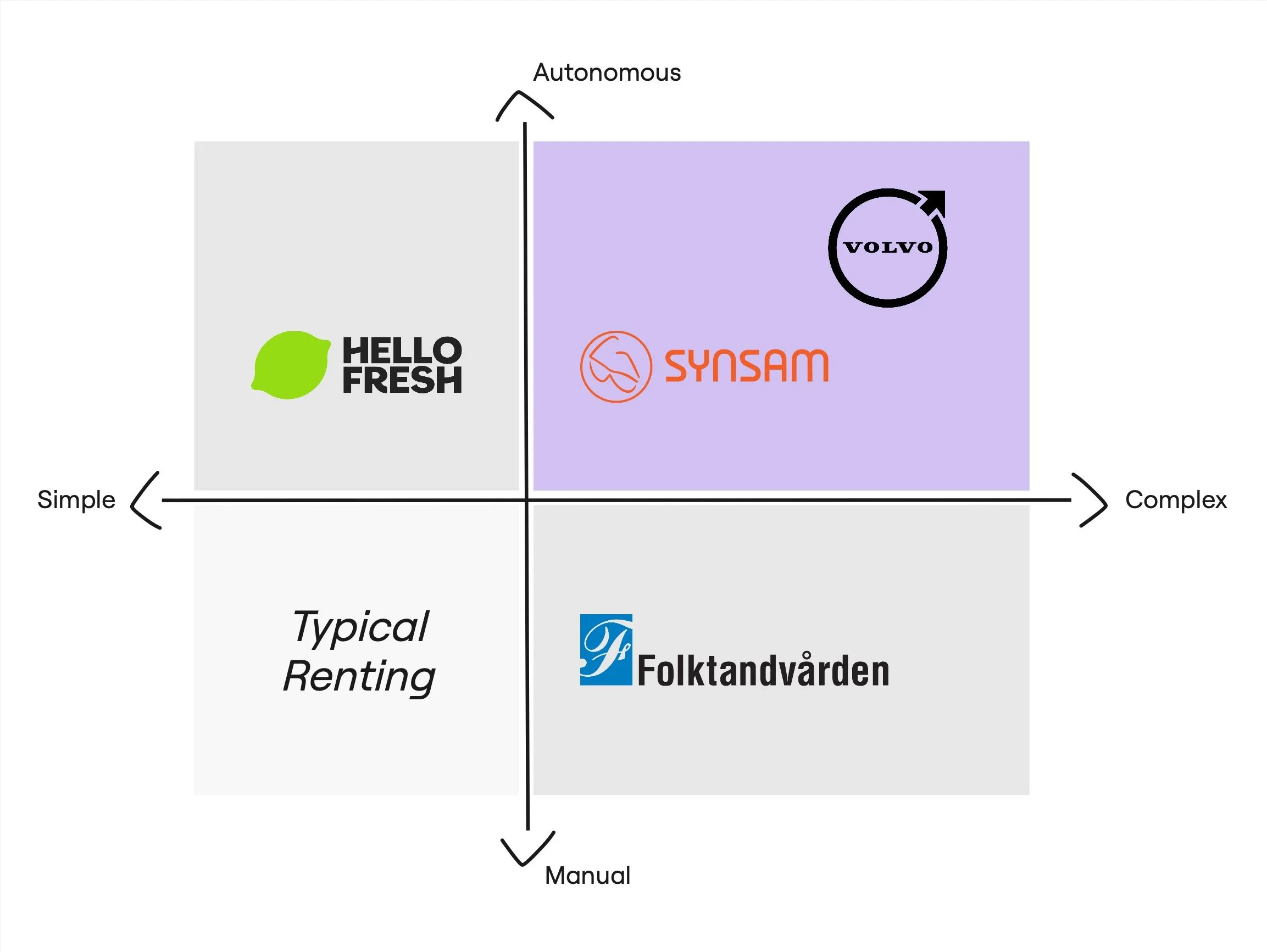
Complexity: Those with high/low complexity, defined as having few or mostly well-known future costs (Simple) vs. many or often uncertain future costs (Complex).
Execution: Those who are built and used in a manual fashion (Manual) vs. those which are built to scale and to be autonomously executed (Autonomous).
Start out in the bottom right (4th quadrant): Complex but manual. A beautiful example of “Simple” done right is Folktandvården’s frisktandvårdsavtal. A dentist examines a patient and puts them in a risk group from 1 to 10. The lower the group, the lower the monthly fee. The judgment behind that number is genuinely complex, it's an estimate of how likely someone is to need care down the line and thus induce further cost for the dentist, but it's made once by a human expert and carried out manually.
Bottom left (3rd quadrant) is the simplest case: typical renting. It’s a set price on schedule for a simple product with well-known unit economics, such as laptops or furniture.
Top left (2nd quadrant) we have the “Simple”, but “Autonomous” methods. This is where we may place Hello Fresh, or a Swedish equivalent like Linas Matkasse. Their costs are fairly straightforward: mostly the price of raw ingredients, applied to a somewhat predictable number of boxes. The pricing still runs through an automated engine because it needs to scale, but since the underlying costs are simple. Investments in a structured data platform to handle the ingoing parameters is nice to have rather than something you actually need.
Top right, complex and autonomous, is where things get genuinely interesting. This is where an offering has plenty of unknowns, yet the company still has to commit to a price in advance. Synsam's lifestyle subscription and Volvo Cars' “Care by Volvo” both sit here. Both need to estimate how likely a customer is to swap the product mid-subscription, how hard they'll use it, how that affects lifespan and residual value, and on top of that, the cost of every service bundled in alongside the core product, whether that's car servicing, eye exams, or transport logistics.
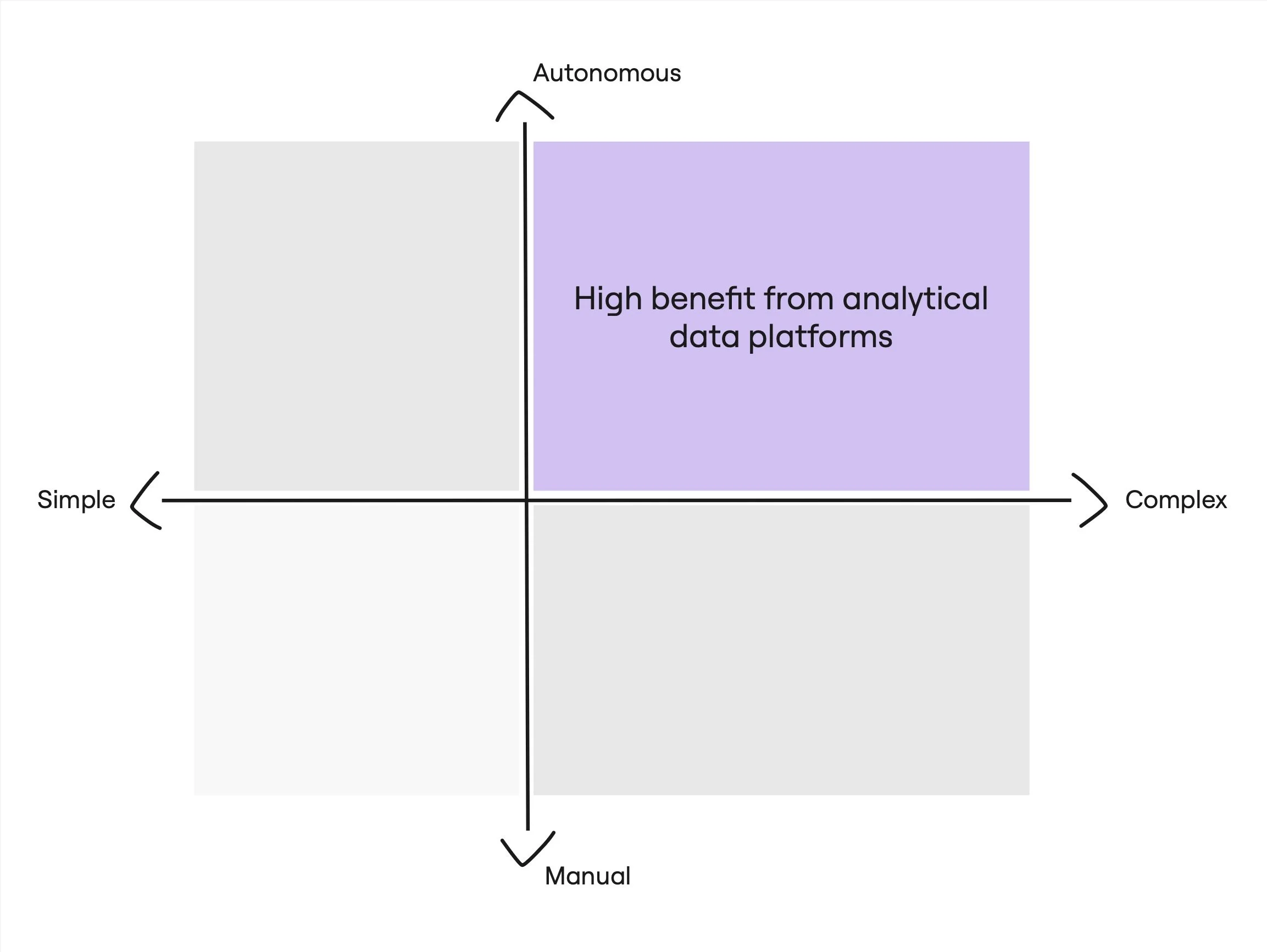
This top right quadrant is the one that gets me most excited as a data person, because it's where scalable data solutions actually make a real difference: either by making predictions more accurate, or by cutting the time and effort needed to keep those predictions up to date.
The recipe for success
So, what can you actually do to get this right, no matter which quadrant you're in?
Decide who owns the numbers. Once a model has more than a handful of cost drivers, someone needs to be responsible for keeping each one current. A smaller offering can get away with one central owner. Something as sprawling as automotive usually can't, so ownership gets spread out to the people closest to each cost driver instead. Either way works, as long as the decision is made on purpose rather than by default.
Then match how often you update the model to how fast the underlying costs actually move. Energy prices that drift slowly might only need a monthly refresh in a spreadsheet. A cost that tracks an hourly spot market deserves a live feed instead. Most teams either update too rarely and get caught off guard, or build automation they never really needed.
Finally (a cause close to my heart), probabilistic models. Residual value, usage, procurement costs, energy prices, none of these are fixed facts. They're probabilities that shift as new information comes in. A model that only ever produces one confident figure is quietly hiding how much it doesn't know. Techniques like Monte Carlo simulation let you show a ranges and probabilities instead, closer to how the world really works.
But showing a range is only half the job. The real value shows up when the model can learn from what you observe along the way, and feed that back in, not just into the model itself but, when it matters, into the price too. Say a new generation of some product comes out, glasses, cars, doesn't matter, at a lower price with the same performance. That's new information, and your assumption about residual value should get challenged the moment you hear it. Residual value comes from current market prices, not from what was originally paid. A model built well should be able to take in that kind of insight and adjust all downstream dependencies effortlessly.
None of this needs an army of data scientists and engineers on day one. It needs clarity on what your model must know, who's responsible for keeping it honest, and how much uncertainty you're willing to admit to. Do that, and “-as-a-Service” pricing stops looking like gut feeling and starts being something you can actually stand behind.
Predictions are hard, especially about the future.
(Niels Bohr)
…so next time you come across one of these subscription offerings out in the wild, it's worth a second to appreciate the work sitting quietly behind that one subscription fee.